
Why the Starting Point Matters: Key Takeaways from the Recent Decision T 0610/24

The following provides a summary of the very recent decision T 0610/24, in which the Board of Appeal examined the criteria for selecting an appropriate starting point when assessing inventive step under the problem-solution approach. In particular, it clarifies the circumstances in which a prior‑art document can be regarded as a suitable starting point and how this selection influences the subsequent obviousness analysis.
Key take-away: If a document does not represent a realistic starting point, it cannot be used for inventive step. The examining division must then go and find a better document.
Brief Outline of the Procedure
The case concerns the European patent application EP 3 756 153 A1 disclosing a chemical pump compatibility management system designed to ensure that chemical pumps are supplied only with chemical compositions from reservoirs compatible with the pumps’ internal components.
To this end, each chemical reservoir is equipped with an electronically readable medium (e.g., barcode or RFID tag) containing information about its chemical contents. A portable computing device reads this information, receives a pump selection, queries a compatibility database, and provides the user with an indication as to whether the selected chemical is suitable for the selected pump.
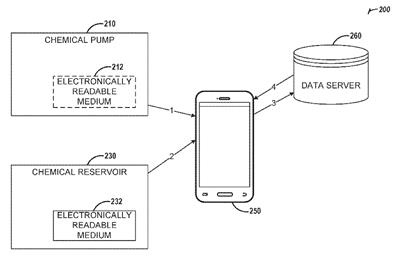
Figure 1: Pump compatibility management system of EP 3 756 153 A1
The Examining Division refused the application for lack of inventive step in view of the prior‑art document D5 (US 2010/0024915 A1). D5 discloses an RFID‑controlled chemical dispensing system in which RFID tags on chemical source containers and receiving containers are checked for compatibility before a solenoid‑operated diluent valve is opened to dispense the selected diluted chemical.
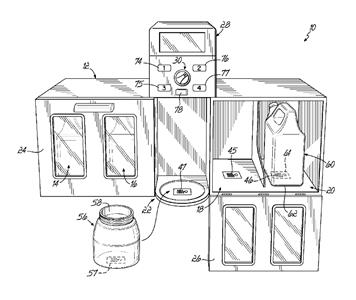
Figure 2: Dispensing system of D5
Although the Examining Division acknowledged differences – namely that D5 assesses compatibility between a chemical and a receiving container rather than between a chemical and a pump, and that D5 does not involve a portable computing device – it considered the claimed distinguishing features to be obvious modifications.
The Applicant appealed, and the Board agreed with the Applicant. In particular, the Board held that D5 is not an appropriate starting point for the assessment of inventive step, as it is directed to a different purpose and does not disclose the structurally most relevant component of the claimed invention, namely the pump. In this context, the Board outlined general principles governing the proper choice of a starting document for the problem-solution approach, which are discussed below.
The Board’s Findings
When assessing inventive step, the problem-solution approach generally allows different potential starting points, including both the closest prior art and more remote prior‑art routes. As the Board recalls, established case law holds that the closest prior art is typically a document that pursues the same purpose or aims at the same objective as the claimed invention and has the most relevant technical features in common, thereby requiring only minimal structural modifications to reach the invention.
Although it is not mandatory to start from the strictly closest prior art – an invention may still lack inventive step if it is obvious from any legitimate starting point – the Board stresses that it is recommended to start from prior art having a similar purpose and similar overall technical effect. Starting from a more remote document often leads to an ex post facto analysis, in particular to the construction of a “hindsight problem” that the skilled person would not realistically have formulated without knowledge of the invention.
In this case, the Board concluded that D5 is not a suitable starting point. D5 neither shares the invention’s objective nor discloses its key structural component – the pump – which is indispensable for the very technical problem addressed (chemical compatibility of pump components) to arise. A meaningful assessment must therefore begin with prior art involving an actual chemical pump and addressing compatibility issues associated with the pump’s materials.
However, the Board noted that such prior art had not been covered by the original search. As a result, the Board could not exclude that a more appropriate starting document exists. To enable a complete and technically sound inventive‑step assessment, the Board therefore remitted the case to the Examining Division with instructions to carry out a new, comprehensive search including prior art on pumps and their chemical compatibility.
Comments
This decision provides a clear and welcome reminder of the importance of selecting an appropriate starting point in the context of the problem-solution approach. Although it is not mandatory to identify the closest prior-art document, the selected starting point must nevertheless be aligned with the invention’s purpose and exhibit a comparable technical effect. Only under these conditions can an inventive‑step assessment proceed without drifting into hindsight.
Accordingly, the Board criticizes the Examining Division for relying on a document that neither pursues the invention’s purpose nor discloses its structurally essential element, namely a chemical pump. As the Board explains, starting from such a remote disclosure invites a hindsight‑driven reconstruction of the technical problem. This reasoning aligns with a line of established decisions (including T 570/91, T 439/92, T 1040/93, T 35/95, T 739/95, T 255/03, T 817/94, T 749/11, and T 535/10), all of which emphasize the central principle that the selection of the starting point shapes – indeed governs – the subsequent reasoning of the skilled person.
What makes this decision particularly noteworthy is that the Board insisted that the starting point must be one from which the technical problem actually arises. Since D5 is concerned with preventing mislabeling in chemical dispensing – and does not even disclose a pump – the issue of chemical compatibility of pump components cannot logically emerge from such a disclosure. This reinforces a fundamental principle: inventive‑step reasoning must be grounded in a realistic technical context rather than reconstructed with the benefit of hindsight.